Installing An Over The Range Microwave


Here is one of the pictures featuring the Installing An Over The Range Microwave. Numerous images associated with the Installing An Over The Range Microwave can be utilized as your point of reference. Below, you'll find some additional pictures related to the Installing An Over The Range Microwave.

Showing posts sorted by relevance for query Installing An Over The Range Microwave. Sort by date Show all posts

Installing An EV Charger At My House Was Easy


Installing an EV Charger at My House Was Easy


Installing an EV Charger at My House Was Easy

With more and more electric vehicles coming through our test fleet -- including our long-term 2022 Mini Cooper SE -- I decided it was time to install a home charger. It's crucial for me because I live in a small desert town and the only public chargers are Level 2 units that deliver electricity at a super-slow speed of 8.3 kilowatts. The last thing I want to do is sit in the parking lot of the California Welcome Center for hours on end.

My first step was to look at my home's electrical panel and see if it could accommodate a Level 2 charger. I have a 100-amp panel and I want to charge at 50 amps, which should let me put 37 miles worth of juice back into the long-term Mini in about an hour. But I didn't want to have to upgrade my house to a 200-amp panel, which I thought I might need to do since I'd want to run things like the air conditioner at the same time.

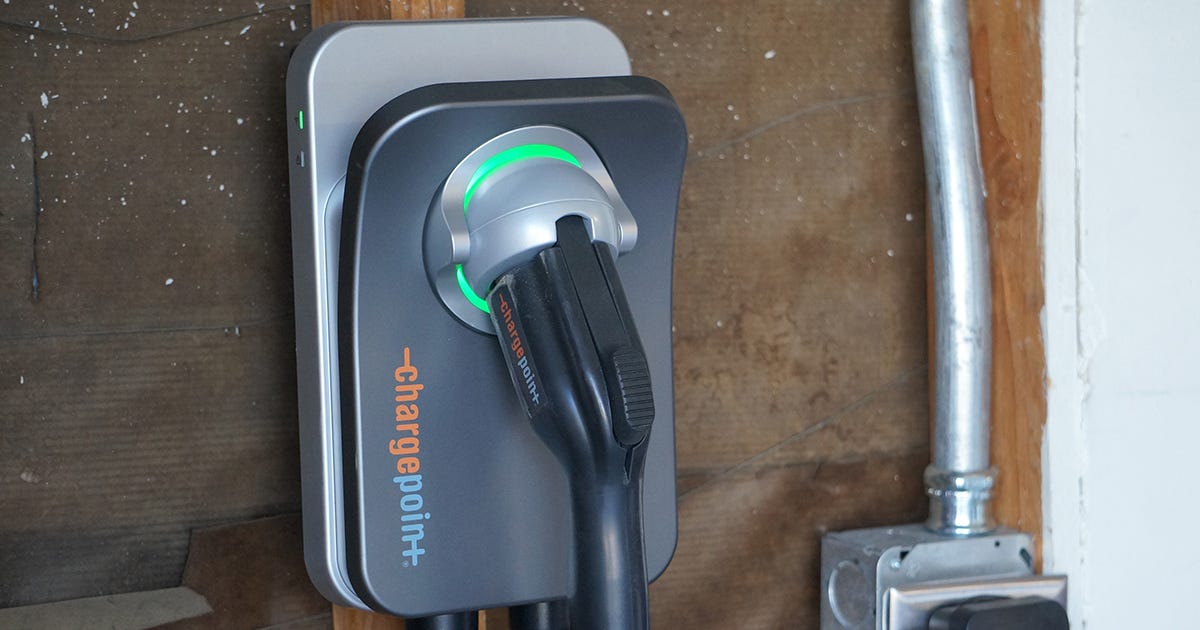
The $699 ChargePoint Home Flex charger I bought can be set to a variety of amps, from 16 all the way up to 50. A good middle-ground charging speed is 40 amps, which puts about 30 miles of range back into the Mini each hour. Plus, by keeping the charging speed below 48 amps, I didn't need to have the charger hardwired to the house, which saved a few dollars during installation, and I didn't have to upgrade to the 200-amp panel. It's good to know that, if I'm hit with a heat wave, I can set the charger's amps lower and still crank the air conditioning.

With our long-term Mini Cooper SE's small battery, home charging is a must.

Emme Hall/CNET

What I like best about my ChargePoint charger is the app. I can use it to find public charging stations when I'm out and about, but I can also use it to schedule my home charging schedule, set reminders, check on charging activity and adjust the amperage remotely.

My local electrician installed the ChargePoint L2 charger for right around $2,000. That included running conduit from the panel in the back of the house under the eave of my home and into the garage, pulling wire through said conduit and then installing a junction box and wiring up the charger. My electrician also added a 240-volt box for a future welder I want to purchase, so I probably could've saved some money if I hadn't asked for that extra work.

Just as there are incentives for buying an electric vehicle, there are also incentives for installing a home charger. The ChargePoint website has a handy search function so you can find rebates in your state. Unfortunately, my utility company and my county in California don't participate. Maybe you'll have better luck.

Not everyone can install a charger at home; renters definitely don't all have this luxury. But having the home charger has improved my time with the Mini, especially since it has a tiny 32.6-kilowatt-hour battery pack that gets an EPA-estimated 114 miles of range. In our testing, we've been seeing anywhere between 110 and 115 miles, but for me, that's one trip into Los Angeles. Having a charger at home -- especially one with an app like ChargePoint's -- means I can plug in and charge when it's most convenient. No more waiting around in the parking lot.


Source

Tags:

How To Install An Air Purifier


How to install an air tag with my iphone how to install an air gap for dishwasher how to install an over the range microwave how to install angular how to install an electrical outlet how to install windows 10 how to install vinyl plank flooring how to install ring doorbell how to change yahoo to google how to download youtube videos
How to Install an Air Purifier


How to Install an Air Purifier

This story is part of Home Tips, CNET's collection of practical advice for getting the most out of your home, inside and out.

An air purifier can go a long way toward reducing potentially harmful allergens in your home. If set up and maintained correctly, it can help rid rooms of volatile organic compounds that hurt your indoor air quality. A portable air purifier is particularly useful since it can move from room to room to provide relief where needed. 

Here we'll walk through the steps to install a standard room air purifier. 

Read more: Best Air Purifiers of 2022

Installing an air purifier

CNET Home Tips logo

To get the basic steps to install a portable air purifier, I consulted several user manuals from different air purifier manufacturers. Specifically, I looked at installation instructions from Honeywell, Shark, Levoit and Crane. The steps are straightforward, but important to ensure your air purifier works optimally.

Step 1: Install the air filter

Air purifiers come with at least one air filter, sometimes more. Before you begin, you'll need to remove any filters from their packaging and follow the guidelines to install them in your air purifier. Some models come with the filter already in place, but it still needs to be removed from its packaging before operation. If your air filter is already installed, check to make sure it isn't still in its packaging before you start using your air purifier. If it is in its packaging, remove it and reinstall your filter. 

Step 2: Position it for use

Most air purifiers require a certain amount of space away from walls, furniture or other objects in your room to function correctly. Again, check your specific use and care manual for the exact distances, because they'll likely vary from brand to brand and model to model. Shark suggests setting its unit "at least" 3 inches from walls, whereas Levoit stipulates a minimum of 15 inches and Crane says its unit needs to be at least 3 feet from walls. 

Depending on the size of your room, these distances can make a big difference and could help you decide which unit to buy. If you want to use your air purifier in a smaller room, having to install it three feet from the wall (like the Crane user guide suggests) might become an inconvenient tripping hazard. 

Step 3: Avoid blocking the grilles

Whatever distance the manufacturer suggests, you also want to make sure the grilles are clear of furniture, curtains and other obstacles that could impede the air purifier's performance. Always face the purifier into the room, rather than toward a wall or furniture. 

Still have questions? Read more about how to position an air purifier for best performance and learn how to clean and maintain an air purifier so it lasts as long as possible.

Other things to note

Keep in mind that these steps could vary slightly depending on the specific model you have. Be sure to consult the user manual for your product before you get started to make sure you're following the proper use and care guidelines. If you have questions, check with the manufacturer directly. 

For some other simple home hacks, consider adjusting the temperature of your water heater, weatherstripping your windows and doors and changing the rotation of your ceiling fan.


Source

https://kcolomadu.jawop.my.id/

.

Search This Blog

Menu Halaman Statis

close