How To Install An Ev Charger


Here is one of the pictures featuring the How To Install An Ev Charger. Numerous images associated with the How To Install An Ev Charger can be utilized as your point of reference. Below, you'll find some additional pictures related to the How To Install An Ev Charger.

Showing posts sorted by relevance for query How To Install An Ev Charger. Sort by date Show all posts

Installing An EV Charger At My House Was Easy


Installing an EV Charger at My House Was Easy


Installing an EV Charger at My House Was Easy

With more and more electric vehicles coming through our test fleet -- including our long-term 2022 Mini Cooper SE -- I decided it was time to install a home charger. It's crucial for me because I live in a small desert town and the only public chargers are Level 2 units that deliver electricity at a super-slow speed of 8.3 kilowatts. The last thing I want to do is sit in the parking lot of the California Welcome Center for hours on end.

My first step was to look at my home's electrical panel and see if it could accommodate a Level 2 charger. I have a 100-amp panel and I want to charge at 50 amps, which should let me put 37 miles worth of juice back into the long-term Mini in about an hour. But I didn't want to have to upgrade my house to a 200-amp panel, which I thought I might need to do since I'd want to run things like the air conditioner at the same time.

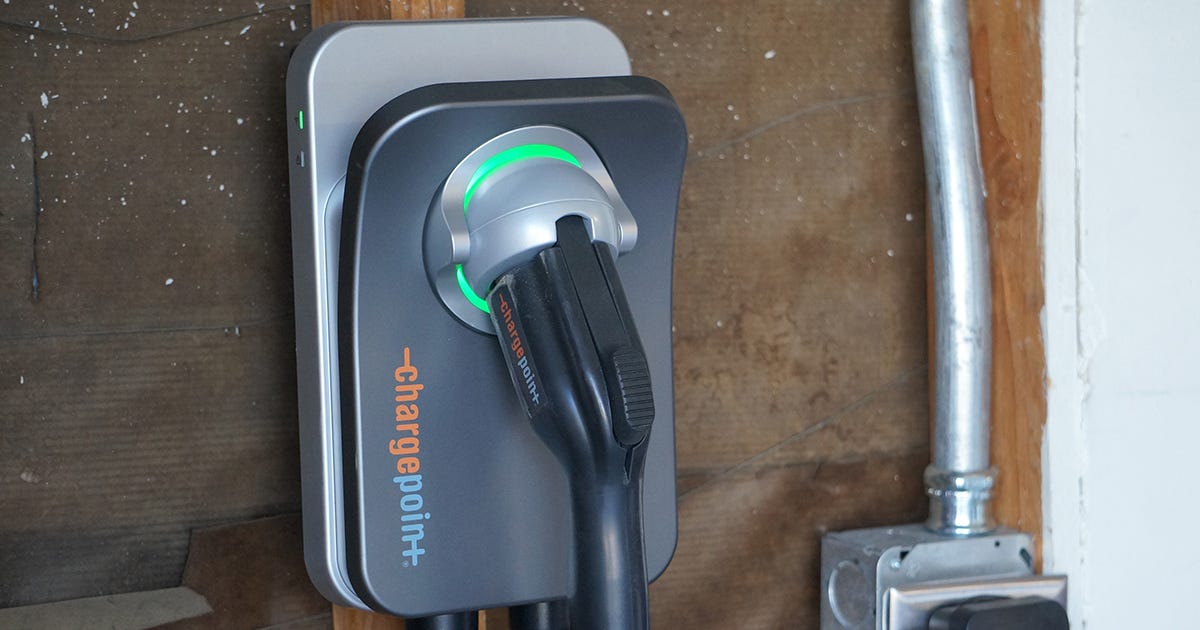
The $699 ChargePoint Home Flex charger I bought can be set to a variety of amps, from 16 all the way up to 50. A good middle-ground charging speed is 40 amps, which puts about 30 miles of range back into the Mini each hour. Plus, by keeping the charging speed below 48 amps, I didn't need to have the charger hardwired to the house, which saved a few dollars during installation, and I didn't have to upgrade to the 200-amp panel. It's good to know that, if I'm hit with a heat wave, I can set the charger's amps lower and still crank the air conditioning.

With our long-term Mini Cooper SE's small battery, home charging is a must.

Emme Hall/CNET

What I like best about my ChargePoint charger is the app. I can use it to find public charging stations when I'm out and about, but I can also use it to schedule my home charging schedule, set reminders, check on charging activity and adjust the amperage remotely.

My local electrician installed the ChargePoint L2 charger for right around $2,000. That included running conduit from the panel in the back of the house under the eave of my home and into the garage, pulling wire through said conduit and then installing a junction box and wiring up the charger. My electrician also added a 240-volt box for a future welder I want to purchase, so I probably could've saved some money if I hadn't asked for that extra work.

Just as there are incentives for buying an electric vehicle, there are also incentives for installing a home charger. The ChargePoint website has a handy search function so you can find rebates in your state. Unfortunately, my utility company and my county in California don't participate. Maybe you'll have better luck.

Not everyone can install a charger at home; renters definitely don't all have this luxury. But having the home charger has improved my time with the Mini, especially since it has a tiny 32.6-kilowatt-hour battery pack that gets an EPA-estimated 114 miles of range. In our testing, we've been seeing anywhere between 110 and 115 miles, but for me, that's one trip into Los Angeles. Having a charger at home -- especially one with an app like ChargePoint's -- means I can plug in and charge when it's most convenient. No more waiting around in the parking lot.


Source

Tags:

Living EV-Only With Our Long-Term Mini Cooper SE And A LiveWire One


Inside ev mini cooper forum how long does an ev last ev with long range living events living every age living evidence consortium living even after death organ donation
Living EV-Only With Our Long-Term Mini Cooper SE and a LiveWire One


Living EV-Only With Our Long-Term Mini Cooper SE and a LiveWire One

Electric vehicles are more common than ever, as are public charging stations that offer Level 2 or DC fast-charging. But there are a lot of folks who are still hesitant to take the plunge on EV living. I'm one of them, so I decided to spend a month exclusively driving EVs -- specifically, our long-term Mini Cooper SE and a LiveWire One motorcycle.

We've talked about our long-term Mini on CNET before. And while I generally agree that it's fun to drive, nicely equipped and easily the best car in Mini's current lineup, I'm not so sold on its EPA-estimated 114 miles of range, which, frankly, I've yet to see.

Still, as a city car, the Mini SE excels. Its small size and nimble handling make it a breeze to whip around in Los Angeles traffic, and it's easy to park in tight city spaces. The ride is on the stiff side, but it's not overly bouncy or jarring, and the interior is nicely appointed, with enough room in the back for a large grocery trip.

My issue with the Mini comes down to charging speed. Plugged into a DC fast-charger, the Mini maxes out at 50 kilowatts, and because the battery isn't that big (32.6 kilowatt-hours), this means going from 15% to 80% usually takes about 30 to 45 minutes. If this car had more range, that wouldn't be too big of an issue, but it's less convenient when you have to charge this frequently. I understand that a lot of EV buyers will likely install a Level 2 home-charging setup, but not everyone can. Looking at you, people who rent or live in apartment or condo complexes.

As basic transportation for me and my wife, the Mini is good but not ideal. With a few modifications to my home setup, I could make it work easier, but in a world where I need to rely solely on public charging, a longer-range EV is a must. More range means more money, though, and the Mini SE's $30,750 starting price (including destination) is definitely attractive.

Like the Mini, the LiveWire One -- the new name for the Harley-Davidson LiveWire I reviewed in 2020 -- doesn't offer a staggering amount of range, but that's less of a concern on something as specialized as a motorcycle. The LiveWire will do over 100 miles in the city when ridden in a spirited fashion. It's very cool; when you get above 60 mph, the sound of the wind rush overtakes the sound of the electric motor and tires, so it almost feels like you're flying. It's addictive.

Mini Cooper SE and Livewire One parked facing each other in front of a cliff

A very good pair.

Steven Ewing/CNET

The LiveWire is capable of DC fast-charging, but as with the Mini, the experience is a mixed bag. I frequently have to disconnect and reconnect the cable in order to get the 15.5-kWh battery to charge. The LiveWire can't accept Level 2 charging, which is a major bummer, so my lack of a home charger is a moot point in this case. Instead, I have to plug into a 110-volt household outlet, and the LiveWire takes about 8 hours to charge this way.

The LiveWire is a lovely bike, but at about $22,000, it's way too expensive -- and that's a drop from when the original Harley-Davidson-branded version launched. The bike's issues are less the fault of LiveWire specifically and more the realities of electric motorcycles in 2022. They just haven't received the same kind of development investment as cars, but at least products like the LiveWire feel like real motorcycles, rather than just jumped-up e-bikes.

So what did going electric for a month show me? First, I haven't lost any enthusiasm for EVs -- cars and motorcycles alike. This month of all-electric motoring showed me just how close these cars and bikes are to not needing any justification for people like me to buy them. Get a home charger and you're fine. Now I'll just wait for the public infrastructure to catch up.


Source

Search This Blog

Menu Halaman Statis

close