Halloween is almost here, so you only have a few days left to source ideas and set up your spooky-season decor. Luckily, we found some amazing high-tech indoor and outdoor decor and the best Halloween decorations available on Amazon Prime that are sure to scare all your friends. These decoration ideas and props can help turn your house in to a haunted mansion and will give you some scary Halloween party ideas.
Read more: The coolest Halloween costumes you can get on Amazon in 2019
Note that CNET may get a share of revenue from the sale of the products featured on this page.
Read more: Easiest costumes for Halloween 2019
Read more: Halloween kitchen gadgets and party gear to help you slay this year's bash
AtmosFX via Amazon
Add a haunted family of four to your guest list this Halloween. Don't worry. They won't eat much. Because they're dead.
AtmosFX Digital Decorations brings you this projector-compatible DVD that will project these four ghoulish guests right into your living room with an easy setup. Just pop the DVD into a DVD player and attach the video output to a projector for your own haunted mansion. The video will also play on a regular TV or monitor.
Read more: Raise your Halloween game with a free AtmosFX digital decoration
Rubie's via Amazon
Stranger Things fans, this one's for you. You can deck your walls with Joyce Byers' famous alphabet-light communication device to wow your dinner party guests.
And since it's also arguably a Christmas decoration, it won't even be weird if you leave it up through the December season.
LUKAT via Amazon
When someone approaches your door to trick or treat, this ghoulish guy will greet them with blinking red eyes that glow and a sinister laugh. There's a motion-detecting sensor that hangs beneath the skull to trigger the action and make your front door seem haunted.
Make sure you have some place high to hang this from. It's over 5 feet tall.
Easife via Amazon
It's not too late to score a spooky fog machine and give your Halloween setup the ambiance of an old, forgotten graveyard at dusk.
This one has a remote control and colored LED lights, which means they aren't cheap Halloween decorations, but they'll match the mood of your event. Fog fluid is sold separately.
Read more: Sexy Mister Rogers Halloween costume horrifies the internet
Bet you didn't know Google Pixel phones were this good
Bet you didn't know Google Pixel phones were this good
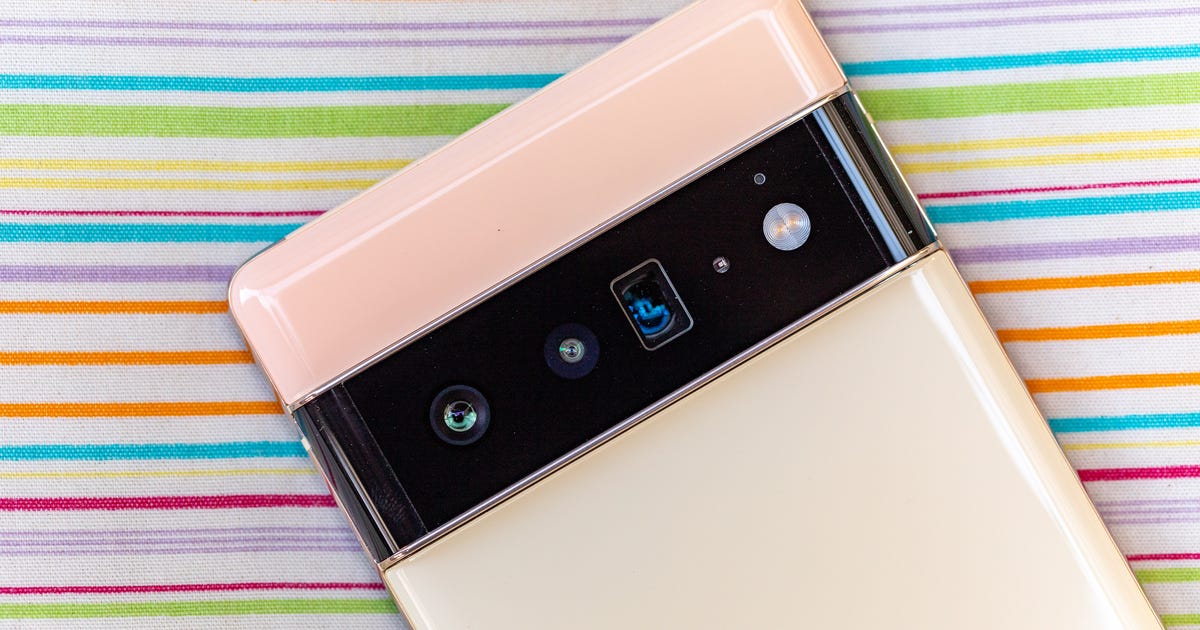
Are you looking for a smartphone with Google Photos, Chrome, Gmail and Google Drive integration? If so, a Pixel might be a good choice for you. Google offers many iterations of its Pixel phones, including the Pixel 4A and Pixel 5, and now the new Pixel 6 and Pixel 6 Pro that come with the company's in-house Tensor chip.
Pixel phones are known for taking great photos. But it isn't just about having an excellent camera and luxurious hardware: Software and the services that a phone ties into are also important. Let's get into a few of these.
Read more: CNET's Pixel 6 and Pixel 6 Pro reviews
Unlimited storage for Google Photos
One big reason to get a Pixel is unlimited storage in Google Photos. Unlike other non-Pixel handsets, Pixel phones have no data cap for backing up photos to the cloud. Photos you take on a Pixel will be saved in their original quality, not automatically compressed to save space. The extent of this benefit varies based on the Pixel you pick up: If you can find the first Pixel phone released in 2016, you should be able to upload photos at original quality for the life of the device.
Read more: Google Pixel 6 vs. 6 Pro vs. Pixel 5 vs. 5A
Pixel phones will enjoy unlimited storage on Google Photos. Other handsets will not.
Sarah Tew/CNET
Later Pixel phones, such as the more recently released Pixel 5 and Pixel 4A 5G, allow unlimited photo uploads at a compressed storage-saver quality. Google outlines the rules for each Pixel phone on this support page.
Unfortunately, it does appear the 2020 Pixel phones will likely be the last to get the unlimited storage benefit. Google does not plan to extend this benefit to the next wave of Pixel phones, according to several reports from The Verge and Tom's Guide, among others.
Read more:What's Pixel Pass?
No bloatware, ever
The menace of unwanted apps, services and often redundant software features continues to plague most Android phones subsidized by US wireless carriers. Not so with Google Pixel handsets. What you get is the pristine Android OS the way Google originally designed it, not masked with odd skins, proprietary overlays or strange UIs.
Pixel phones have access to beta software like new OS versions and features.
Google
Fresh Android OS updates
Besides unfettered storage for photos, Google has pledged to make updating its Pixel phones a priority. Whenever a new Android OS version or security patch rolls out, it'll arrive on Pixels first. That includes new features separate from full OS updates. And for the truly adventurous, Pixels have first dibs on beta Android versions as well.
All Pixel phones are available in Google Fi cellular network versions.
John Kim/CNET
Google Fi is always an option
While not a massive force in the wireless carrier market, Google does offer its own cellular service for mobile devices. Called Google Fi (not to be confused with Google Fiber), this MVNO-style system offers pay-as-you-go data plans. It also uses technology that enables seamless switching between Wi-Fi and cellular networks during voice calls.
All Pixel phones come in versions specifically designed to operate on Google Fi. These phones are also unlocked so you can port them over to another carrier if you'd like. For instance, the Pixel 5A is available in both Unlocked and Google Fi (also unlocked) versions.
Things get more complicated, though, when choosing a Pixel 6 or Pixel 6 Pro. Google sells three varieties of each: Verizon, Google Fi (unlocked) and Unlocked (no specific carrier). The models without a specified carrier will work on all major US carrier networks. That said, they aren't all fully compatible with each carrier's 5G network.
Squash that spam
If you're constantly assaulted by a deluge of unwanted scam or shady marketing calls, then you'll find this Pixel feature compelling. The Pixel Call Screen function in the phone app works with Google Assistant to stop robocalls from reaching you. Together they can prevent unknown callers from making your phone ring, or screen calls for you in real time.
A sweet phone deal
Right now one of our favorite phones on the market is the $399 Pixel 5A. Compatible with 5G cellular networks, this budget-friendly handset has an excellent ultrawide camera and a big OLED display. It also enjoys strong software support from Google and the promise of timely updates for up to three years. And at $500 less than the price of the $899 Pixel 6 Pro, or $200 less than the $599 Pixel 6, it's a tempting alternative.
Awesome Hyundai RN22e Concept Previews Potential Ioniq 6 N EV
Awesome Hyundai RN22e Concept Previews Potential Ioniq 6 N EV
After releasing the full details of its Ioniq 6 electric sedan, Hyundai wasted no time unveiling the new RN22e concept at its N Day event Thursday, previewing what a future Ioniq 6 N could be like. Hyundai describes the RN22e as a rolling lab concept, with its design and engineering set to directly influence future production EVs.
The RN22e uses the same 77.4-kilowatt-hour battery pack as the standard Ioniq 6, but its dual motors have been boosted to produce 577 horsepower and 546 pound-feet of torque, increases of 257 hp and 100 lb-ft over the Ioniq 6. (That figure also matches the Kia EV6 GT.) Hyundai doesn't give any acceleration figures, but the RN22e has a top speed of more than 155 mph. It also has the same fast-charging capability as the normal Ioniq 6, with the ability to go from 10% to 80% charge in under 18 minutes.
Hyundai says the RN22e was designed to maximize the N brand's three performance pillars: Corner rascal, everyday sports car and race track capability. To achieve the first point, the RN22e has an electronic limited-slip differential, a twin-clutch torque vectoring system and the ability to select the amount of torque being sent to the front and rear wheels on the fly. It also uses a number of 3D-printed parts that reduce weight and increase stiffness. For enhanced track capability, the RN22 has four-piston brake calipers with large 15.7-inch discs, and Hyundai is using the RN22e to develop regenerative braking systems that have improved yaw control. One of the hallmarks of Hyundai's existing N models has been the sound and visceral character, and that isn't lost with the RN22e. It has N-specific noise generators inside and out, and something called N e-shift provides shifting feel and vibration.
This could easily translate to a production Ioniq 6 N.
Hyundai
The RN22e looks like a wild race car version of the Ioniq 6, but it's easy to see how the design could be translated to a production car. Overall the RN22e is 2.4 inches longer and 5.7 inches wider than the standard Ioniq 6, with the wider fenders having large air intakes at the edges of the doors. The headlights are slimmer, there's a large vent in the hood and the front bumper has a massive grille and additional intakes. At the back, the RN22e has a larger protruding diffuser, a huge wing and open sections behind the rear wheels. Other new details include the N brand's signature blue paint in a matte finish with a cool center stripe, 21-inch wheels with Michelin Pilot Sport 4S tires and racing-style side mirrors.
The RN22e may just be a concept for now, but it will be undergoing lots of on-road and track testing to help Hyundai develop future N products. Hyundai also officially announced the production Ioniq 5 N, which will be the brand's first electric performance car available for public consumption when it goes on sale in 2023.
2023 BMW M2 Prototype First Drive Review: Who Needs an M4?
2023 BMW M2 Prototype First Drive Review: Who Needs an M4?
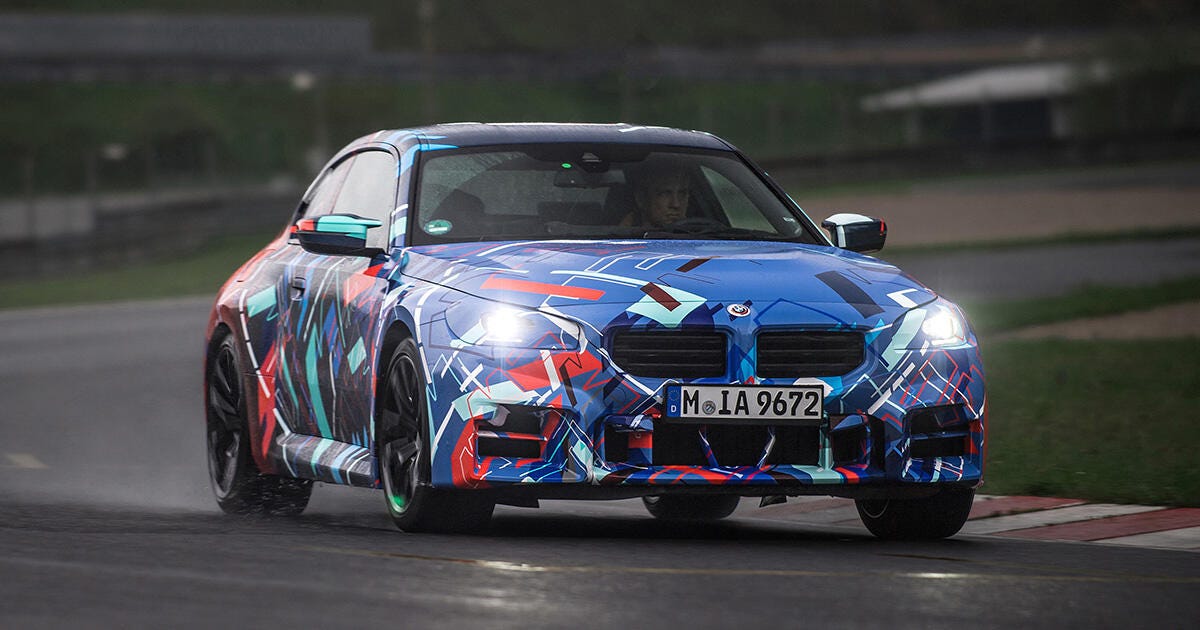
The new BMW M2 puts the engine, chassis and braking hardware from the excellent M4 in a smaller, lighter and more playful package. Sounds good? You betcha. But where will that leave the M4?
This M car commonality isn't really a surprise, considering the current G42-generation 2 Series rides on the same modular CLAR platform that underpins the 3 Series and 4 Series. Compared to the M4, the new M2 has a 4.3-inch shorter wheelbase, but the main structural chassis components are the same. Even the staggered 19-inch front and 20-inch wheels carry over, as do the Michelin Pilot Sport 4S summer tires.
The M2 has a 4.3-inch shorter wheelbase than the M4.
BMW
The differences largely come down to individual tuning. The M2's front springs are stiffer while the rear ones are softer, which gives the coupe quicker turn-in and a more lively back end. In fact, the M2 borrows its rear dampers from the upcoming M3 Touring, as greater damping forces are required due to the softer springs.
BMW tweaked the M4's traction control, electronic limited-slip differential and adaptive suspension systems to be better in line with the M2's improved agility, and the smaller coupe gets a unique steering tune too. Meanwhile, the M4's brake-by-wire system carries over unchanged, and the M2 will have two brake feel settings, though the differences between them aren't super noticeable in practice.
But ripping around Austria's Salzburgring, it doesn't take long to notice the M2's agility. It's way more entertaining to chuck into a corner, the traction control letting the rear axle slip just enough for controlled moments of oversteer during tight turns. At the same time, the M2 never feels like a handful or too difficult to rein in, and that's as true on dry pavement as it is after a brief spring shower soaks the Salzburgring surface.
You'll be able to fit the M2 with the M4's carbon bucket seats, and BMW's curved infotainment display will be standard.
BMW
There's more than enough power to keep the M2 pulling hard, since it uses the fantastic 3.0-liter twin-turbo I6 from the M3 and M4. BMW has yet to confirm the M2's official power specs, but in the M4, this engine puts out 473 horsepower and 406 pound-feet of torque. That's a 68-hp bump over the current M2 Competition but an equal amount of torque. It's also a modest increase over the 444-hp M2 CS.
Like the current M2, the new coupe will be offered with a six-speed manual transmission, though you can also get it with the eight-speed automatic found in the M4 Competition. Both setups have their benefits: The manual is super fun with a notchy shifter and a perfectly weighted clutch, while the automatic fires off instantaneous, well-timed gear changes and gives you the option to choose your own adventure with steering wheel-mounted paddles.
As far as I can tell, the M4 only has two major advantages. First, you can get it in Competition spec, where the I6 has a more powerful state of tune (503 hp, 479 lb-ft). You can also get the M4 Competition with BMW's xDrive AWD system, which adds to the coupe's handling prowess and makes it foul-weather friendly — with the right tires, natch.
The new M2 is expected to go on sale in April 2023.
BMW
From a daily livability standpoint, the M2 won't be all that different from the M4. Its back seat is smaller, but who's actually using that on the regular? You'll be able to option the M2 with the M4's carbon front bucket seats, and BMW's new curved dashboard display and iDrive 8 infotainment tech will come standard.
My theory is that the arrival of the 2023 M2 next April will allow the M4 to move slightly more upmarket, leaning more heavily into the grand tourer side of the equation. Or maybe BMW will kill off the base, rear-drive, manual M4 since it'll have the biggest overlap with the M2. But that's just my own wild speculation. Don't quote me unless I end up being right.
If any of that does come to fruition, that'll give the M2 some more breathing room to be the purest driver's car in BMW's compact M space. Everything about the new M2 seems pretty rad at first blush. But considering the M4 linkage, I'm not exactly surprised.
Editors' note: Travel costs related to this story were covered by the manufacturer, which is common in the auto industry. The judgments and opinions of CNET's staff are our own and we do not accept paid editorial content.
IIHS: Automatic emergency braking has trouble in darkness
IIHS: Automatic emergency braking has trouble in darkness
Automatic emergency braking is a life-saving feature that effectively prevents crashes, even grisly vehicle-to-pedestrian wrecks. But according to a study released on Thursday by the Insurance Institute for Highway Safety, this technology's effectiveness is dramatically reduced in low-light situations. It turns out, just like drivers, cars have trouble seeing at night.
The IIHS found that automatic emergency braking with pedestrian-detection technology reduced crashes of all severities by 27% in all lighting conditions. Wrecks that cause injuries were reduced by an impressive 30%. But there's a bit of bad news in this. The watchdog organization found that at night, on roads that aren't lit, there was no difference in the crash risk for vehicles that feature automatic emergency braking and pedestrian detection compared to models not fitted with these features, a troubling discovery.
Automatic emergency braking absolutely saves lives, but there's a caveat. "Unfortunately, it also shows these systems are much less effective in the dark, where three-quarters of fatal pedestrian crashes happen," says Jessica Cicchino, the author of this study and IIHS vice president of research. Short of installing streetlights on every mile of thoroughfare across the country, automakers will have to improve how these systems work in the dark.
Automatic emergency braking with pedestrian detection absolutely saves lives, it's just often dramatically less effective in darkness.
Honda
To address this issue, the IIHS is developing a new nighttime pedestrian test. Later this year, the organization will publish the first ratings for vehicles evaluated in this category. Ahead of these official scores, the group tested eight small SUVs to see how well they were able to avoid crashing with pedestrians at night. This group included the 2019 Subaru Forester, 2019 Volvo XC40, 2020 Honda CR-V, 2020 Hyundai Venue, 2021 Chevrolet Trailblazer, 2021 Ford Bronco Sport, 2021 Toyota C-HR and 2022 Volkswagen Taos. This wide range of makes and models covers a variety of diffe rent sensing technologies, from single- and dual-camera setups to radar-only affairs.
The performance of these vehicles' pedestrian detection and automatic emergency braking tech declined in the dark and when the low-beam headlights were used compared to high beams. One outlier is the Taos, which only has radar, a sensor that doesn't rely on visible light. Its performance did not decline in the dark, though it was also the worst in daylight driving, so pick your poison. The two best vehicles in nighttime testing proved to be the C-HR and Bronco Sport, both of which have cameras and radar sensors.
Acing the organization's upcoming test may sound like yet another hoop for automakers to jump through, but there's good reason to make sure automatic emergency braking works in all lighting conditions. According to the National Highway Traffic Safety Administration, 6,205 pedestrians were killed in crashes in 2019, an increase of more than 50% since 2009. Putting things in perspective, that total makes up about a third of all traffic fatalities. Beyond that, according to the IIHS "around 76,000 more pedestrians sustained nonfatal injuries in crashes with motor vehicles," so clearly there a lot of work to be done here.
Google Says Search Got Much Better at Identifying Spam Sites Last Year
Google Says Search Got Much Better at Identifying Spam Sites Last Year
Google Search caught six times more spam sites in 2021 than it did in 2020, according to a Webspam report published by Google on Thursday. The Alphabet subsidiary lauded its AI-based spam-prevention system called SpamBrain, which it said has helped keep "more than 99% of searches spam-free."
SpamBrain has helped prevent users from clicking to harmful sites that might inject malware and to scam sites that aim to trick people into revealing personal information or wiring money, the search giant said. AI-based systems are necessary given that spammers are constantly finding ways to circumvent the company's filters, Google said.
Search is Google's most significant revenue driver, making it important for the company that high quality and safe sites rise to the top of its results. Spam sites use search engine optimization, or SEO, techniques to artificially improve their search rankings. Google filters out spam sites designed to trick its algorithm.
SpamBrain led to a 70% reduction in hacked spam, Google said. Hacked spam involves hackers infecting websites with harmful code that can record people's keystrokes and steal their login credentials. Other types of hacked spam can inject malware onto people's computers and redirect them to malicious sites. SpamBrain helps keep these websites out of Google Search, Google said.
"Scammers often attempt to create low quality websites with keyword stuffing, logos of brands they're imitating, and a phone number they want you to call," Ned Adriance, policy communications manager at Google, said in an email. "Our algorithmic solutions work to make sure that scam and fraud are very unlikely to show up in your search results."
Google said it also reduced gibberish spam by 75%. Gibberish spam involves malware or scam sites that use keyword-stuffed nonsensical sentences in an attempt to boost their ranking. Spam sites can also use link spam to game Google's quality signal, known as PageRank. This is done by having other sites link to them, sometimes by offering money, to boost ranking.
"We have many solutions to identify and nullify link spam, and sites engaging in link spam are wasting valuable time and money that could be better invested in better content or user experience," said Adriance.
SpamBrain launched in 2018. Google says search was able to catch 200 times more spam sites last year compared with when it first started weeding out malicious sites nearly two decades ago. Still, it's an ongoing battle between those aiming to abuse or narrowly skirt the company's quality guidelines and Google trying to elevate valuable content.
Getting the right information is crucial when it comes to matters of health, but the presence of an infectious disease in a community has a way of fueling misinformation like wildfire. And in bigger outbreaks, like the 2022 monkeypox outbreak that's now officially a global health emergency, the spread of misinformation can be dangerous.
While monkeypox isn't a new disease, certain aspects of this outbreak set it apart from previous cases. With that, there are several things we know to be true about the way this disease behaves overall.
These are a few common monkeypox myths, debunked.
Myth: Only gay men are at risk of monkeypox
While it's true that the majority of people getting sick with monkeypox right now are men who have sex with men, anyone can get monkeypox regardless of sexual orientation, age, gender or whatever other demographic you can throw at the disease.
The reason it's affecting mostly gay men right now is because, in an uncharacteristic move, monkeypox is currently spreading mostly through sexual contact. Because people who have sex with men have physical contact or intimacy with other gay or bisexual men, the disease has so far mostly been sighted and contained within that community.
But cases have been reported in other demographics, including women and children. Monkeypox can spread to anyone engaged in close contact with a monkeypox-infected person, like someone who lives with them. And health officials fear that shame may deter people from seeking the care they need, including treatments or vaccines if they're exposed. The misbelief that only gay men can get monkeypox could also cause us to ignore spread of the disease in other communities, which may make the outbreak harder to contain.
Read more: Monkeypox: What Gay and Bisexual Men Need to Know
Myth: Monkeypox is easy to catch
Unlike a respiratory virus that spreads relatively easily in a room full of people who aren't touching each other (like COVID-19), monkeypox requires close physicalcontact to spread. That is, someone typically needs to be in direct contact with a person with monkeypox symptoms in order to catch it, or in direct contact with their clothes or another fabric or surface a monkeypox rash has touched. Examples of people who could be exposed to monkeypox if you had it are your sexual partner... or the roommate you share a hand towel with every day.
The virus that causes monkeypox can survive, however, on surfaces -- particularly in dark, cool, low-humidity environments, according to the Centers for Disease Control and Prevention. Because of this, it might be theoretically possible that someone could catch monkeypox from a contaminated surface, but the current likelihood of this remains low. Part of this could be the reason that the amount of virus the person is exposed to plays a part in whether they're infected (sharing a bed every night for a week with a person with monkeypox would be a lot more exposure than touching a public surface once, for example). Direct, skin-to-skin contact, including sexual contact, is the predominant way people have been exposed to monkeypox during this outbreak, according to the CDC.
"It's not a situation where if you're passing someone at a grocery store, they're gonna be at risk for monkeypox," Dr. Jennifer McQuiston, deputy director of the Centers for Disease Control and Prevention's Division of High Consequence Pathogens and Pathology, said at a May briefing with the CDC.
Read more: What to Do if You Think You Have Monkeypox
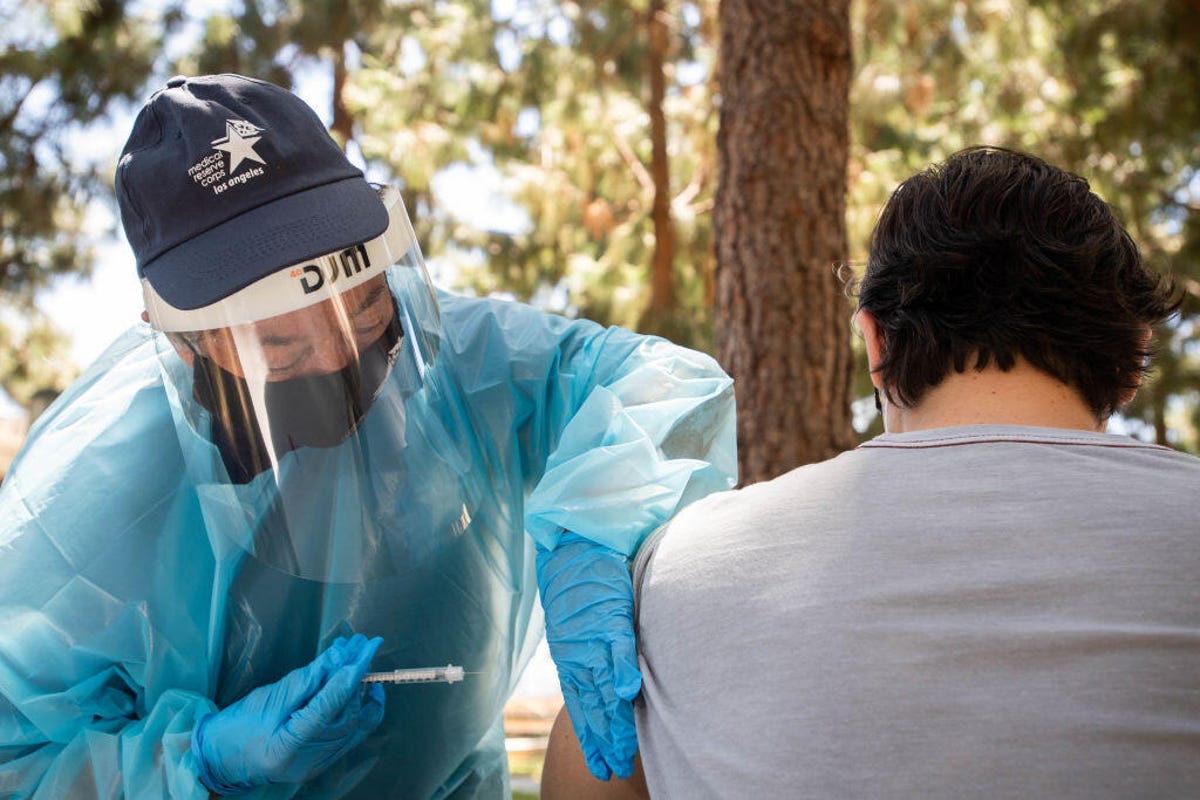
There's a monkeypox vaccine available for people at higher risk of getting the disease. This week, health officials changed the way it can be given in an effort to spread out a low supply and vaccinate more people.
MediaNews Group/Los Angeles Daily News/Getty Images
Myth: Monkeypox is a new disease
In short: No. Several African countries have been battling monkeypox for years, and the disease is endemic in some regions (in other words, it circulates year-round within one area). The first human case of monkeypox was detected in the 1970s, and there was a small (47-case) outbreak in the US in 2003 linked to imported pet prairie dogs. Prior to the 2022 outbreak, most cases of monkeypox were found in rural, remote areas and linked to direct contact with animals that can spread the disease.
Another thing that sets this outbreak apart is that monkeypox cases are spreading in countries where it isn't normally found without a link to international travel (like the US, Canada and select European countries). It's also mostly spreading through intimate contact and being detected in adult men. More cases in earlier outbreaks were in children, and human-to-human transmission was lower.
The current monkeypox outbreak might be linked to a case detected by a Nigerian infectious disease doctor in 2017, NPR reported. Dr. Dimie Ogoina identified a case with characteristics that more closely resemble monkeypox now. Ogoina then noticed the outbreak in Nigeria had spread between men with a link to sexual contact, as opposed to increasing cases among children who are more at risk of severe disease (and had been typically impacted in monkeypox-endemic countries). His and his teammates' warnings to the broader medical community may have fallen on deaf ears as the outbreak spread beyond Nigeria, according to the report.
Myth: Monkeypox is causing another lockdown in the US
The Biden administration declared monkeypox a national public health emergency on Aug. 4. The federal move is supposed to open up more money and funding for resources, including vaccines and testing, and encourage more information-sharing between the local, state and federal levels. It doesn't mean that states or cities will issue stay-at-home orders like they did for COVID-19 before vaccines and treatments became available, however. Unlike monkeypox, COVID-19 was a completely new virus that continues to spread easily between people who may have mild or no symptoms.
Read more: Everything We Know About Monkeypox
Monkeypox has been spreading mostly through direct, skin-to-skin contact.
Kelvin Murray/Getty Images
Myth: There are no monkeypox treatments available
In 2019 the US Food and Drug Administration approved Jynneos, a vaccine for monkeypox and smallpox prevention for people at higher risk of getting these diseases. This vaccine is now being given out to people at higher risk of catching monkeypox, though the rollout has been riddled with supply issues, and appointments have been hard to come by for many.
There's also another smallpox vaccine that can also be used against monkeypox called ACAM2000. However, this is an older live virus vaccine that isn't safe for all people, including the immunocompromised and people with certain skin conditions like eczema. Treatments that have been used to treat smallpox are also thought to work against monkeypox. While most people will be able to recover from monkeypox at home without medical intervention, some people at higher risk of severe disease, like folks who are immunocompromised, may be prescribed an antiviral.
Read more: Monkeypox Cases Up Over 40% This Week: Here Are the Symptoms to Look For
The information contained in this article is for educational and informational purposes only and is not intended as health or medical advice. Always consult a physician or other qualified health provider regarding any questions you may have about a medical condition or health objectives.