Dji mavic mini drone only dji mavic mini drone dji mavic mini camera drone dji mavic mini combo fly more ultralight dji mavic mini ultralight 249g dji mavic mini combo ultralight dji mavic mini ultra light how to charge dji mavic mini controller
DJI Mavic Mini an ultralight drone with 2.7K camera, 30-minute battery for $399
DJI Mavic Mini an ultralight drone with 2.7K camera, 30-minute battery for $399
The DJI Mavic Mini is the company's smallest and lightest camera drone ever. It was designed with the goal of getting the weight down below 250 grams (8.8 ounces), which not only makes it safer, but means in the US you don't need to register with the FAA. The Mini is likely to open up the world of camera drones to a whole new group of people.
The Mini, which starts shipping on Nov. 11 for $400, looks like a smaller Mavic Air, but don't expect that drone's features. This is actually more like DJI's little Spark drone, but the Mini folds and actually weighs less. To get the weight down, the Mini doesn't have any extra sensors for obstacle avoidance or recognition. That means you'll have to learn how not to crash this one on your own.
The good news is you really shouldn't have too much trouble learning to fly it. Like the Spark and other Mavic drones, the Mini is stable and nimble. I got to fly it for a few minutes and it's just as easy and responsive as the others and since it's smaller you can fly it in tighter spaces.
It's also really quiet. I was standing within a few feet of it having a conversation without shouting or having problems hearing. Less noise and a small size will make this a better choice for more discreet, inconspicuous flying, kind of like the difference between shooting pictures with your phone instead of a large SLR camera.
The controller is compact like the drone and folds up nicely. Neither it nor the drone are so large that you'll hesitate bringing them with you. Despite the small size, you do have controls for the camera in back including a tilt dial so you can point the camera straight down, straight forward or anywhere in between. What it can't do is point straight up like Parrot's Anafi.
Left to right: DJI Mavic Air, Mavic Mini and Mavic 2.
Joshua Goldman/CNET
The Mini's camera is a step up from the Spark's. It can shoot video at up to 2.7K at 30 frames per second and 1080 at 60fps and 12 megapixel photos. The camera's on a three-axis motorized gimbal so you'll still get the same smooth video and stable pictures as you would with DJI's other drones.
Also, there's a new streamlined DJI Fly app for the Mini that gets rid of a lot of the onscreen clutter of its other drone apps. That makes it easier to focus on framing your shots and flying. And you still get features like its preprogrammed cinema shots and flying circles or helixes around subjects.
A door on back covers the Mini's small battery pack.
Joshua Goldman/CNET
When I first saw the Mini I fully expected the battery life would be down around 15 to 20 minutes. I was wrong. Between the lightweight body and other design efficiencies, DJI said the flight time is up to 30 minutes on its battery pack. That extra time can easily mean the difference between getting and missing a shot.
DJI has some accessories coming for the Mini, too, including a desktop charging base that looks a bit like a specimen display and stickers to add your own designs to the putty gray body. Also, in addition to the standard $400 package that comes with the drone, controller and a single battery, you can get a $500 Fly More kit with three batteries, charging hub, extra propellers and a carrying case.
The Mavic Mini walks the line between a little backyard flier and a more serious camera drone. But with it being smaller and lighter, it's also safer to fly and when you add that it's also quieter, you've got something you can fly more freely than the company's other drones.
What do you think? Is a more travel-friendly drone that doesn't require registration, but is leaner on features a good move for DJI?
Tunnelbear vpn review reddit how good is tunnelbear vpn tunnelbear vpn uk free how safe is tunnelbear vpn free vpn like tunnelbear who owns tunnelbear vpn tunnelbear vpn free version tunnelbear vpn review tunnelbear vpn review reddit
TunnelBear VPN review: The overpriced ursine has trouble living up to the hype
TunnelBear VPN review: The overpriced ursine has trouble living up to the hype
TunnelBear's gotten a lot of hype in the last couple of years. It was touted by Wirecutter as the New York Times' top virtual private network pick for several months through 2020, US News and World Report ranked it 6th for the year, and PC Magazine and TechRadar liked it too. But when I look at TunnelBear after a year spent under the hoods of its VPN competitors, I just don't get the excitement.
Sure, TunnelBear's speeds are reasonable. And yes, like some of its competitors, it offers yearly transparency reports and has been audited independently. But it's also a Canadian business owned by US-based McAfee, so if you're looking for subpoena-proof international privacy, you're playing with fire. It holds a paltry 23 server locations from which you can't manually choose your server or even a city. It doesn't offer Tor-over-VPN, it only offers split tunneling on Android, and it can't even unblock Netflix.
Read more: The best VPN service of 2022
Why do people like this VPN so much? What am I missing? Is it the cutesy little bear animation that you see when you click the connection button? Is that what's got everyone excited? No judgment. I just want to know.
I know it can't be the cost that makes it so appealing. The TunnelBear plan with the best value is $120 for a three-year subscription with a limit of five connected devices. Meanwhile, competitor Surfshark costs half as much at $60 for a two-year subscription, outperforms TunnelBear on every privacy and feature front, has likewise been independently audited, and allows unlimited connected devices.
By every measurement I've got, TunnelBear is just a slightly overpriced yet middling offering within a privacy-averse jurisdiction, and has all the configuration options and visual appeal of Baby's First VPN by PlaySkool.
Editors' note, Feb. 9, 2022: The VPN industry has undergone significant change in the past few months, with all three of our top VPN choices announcing major changes in corporate ownership. In December, ExpressVPN announced that it had officially joined Kape Technologies, a company that already owns several other VPNs and has raised privacy concerns in the past. In February, NordVPN and Surfshark announced the two companies were merging, though they'll continue to operate autonomously. We're in the process of reevaluating all of our top picks in light of these changes. We will update our reviews and, if necessary, our rankings to account for this new competitive landscape.
Speed
Average speed loss: 63%
Number of servers: 1,800
Number of server locations: 23
Number of IP addresses: Unknown
I ran speed tests using TunnelBear over three days with dynamic IP addresses, in two locations, using both wireless and ethernet connections. Internet speeds in the US vary by state and provider. And with any speed test, results are going to rely on your local infrastructure. Hyperfast internet service will yield higher test speed results.
That's one reason I'm more interested in testing the amount of speed lost (which for most VPNs is typically half or more) across both high-speed and slower connection types, and in using tools such as speedtest.net to even out the playing field. In the case of TunnelBear, nearly 63% of average internet speed was lost. That average includes both the superfast speeds recorded for nearby servers, and the sluggish speeds recorded for the more distant servers.
Read more:All the VPN terms you need to know
Speeds I recorded for TunnelBear placed it near the middle of the VPN pack. It struggled to catch up to the popular NordVPN's overall 32% speed loss, and catching up to other speed-intensive VPNs such as Surfshark and ExpressVPN (which in previous tests experienced overall losses of just 27% and less than 2%, respectively) could be an even bigger problem. TunnelBear's speeds have steadily improved over the years as measured by other review and testing sites, though, and the US scores I recorded saw a speed loss of only 54%.
In my tests, US servers delivered the peak speed of 176Mbps, with an average of 112Mbps. That's more than fast enough to torrent, game, or browse. Non-VPN speeds in the same round averaged about 244Mbps. UK speeds came in second place, averaging 104Mbps. Australia followed in third place, with an average 100Mbps.
Speeds bottomed out in Singapore, though, with a low of 4.95Mbps and an average speed of 68Mbps. TunnelBear's connections routinely faltered when testing in the region. The lowest averages were found in Europe, at 65Mbps overall. As has been the case for every VPN I've tested, German servers underperformed compared to French.
Security and privacy
Jurisdiction: Canada, with US parent company
Encryption: AES-256
Leaks: None detected
Includes kill switch
You want to unblock Netflix, BBC iPlayer, or another streaming service? TunnelBear isn't the best choice. You want to torrent? Yes, TunnelBear offers P2P torrenting on all of its servers but its home jurisdiction of Canada -- a member of the Five Eyes international mass surveillance and intelligence-sharing agreement -- is known to come down hard on copyright violations when they're caught. As is the US, where its parent company McAfee is headquartered.
Notably, TunnelBear isn't making the same "no logs" promise that many other VPNs make. It is open about collecting what would normally be considered very limited connection logs -- as opposed to usage logs -- which include data on your bandwidth use and whether you've used TunnelBear in any given month, and which version of the app you've installed on which OS.
I prefer a VPN keep no logs, especially a VPN located inside a country that's part of an international intelligence-sharing ring. But TunnelBear is holding its own in the transparency competition among VPNs by publishing the results of its independent security audits and annual transparency reports that are presented in plain, easily understood language. Those reports tell us that from September 2018 to September 2019, TunnelBear received 10 government or legal requests for user information.
Those reports also tell us something arguably more important: When TunnelBear is alerted to a significant service or security issue, the company addresses and fixes it. When it contracted Cure53 for its third independent security audit (released in January), TunnelBear set about fixing issues post-haste. While TunnelBear isn't the only VPN with routine audits and transparency reports, this is the kind of habitual transparency we should all expect from every VPN on the market.
No IP address, DNS or other potentially user-identifying data leaks were detected during our testing, but in the past TunnelBear was observed to have been leaking WebRTC information on at least two occasions. TunnelBear's encryption is standard AES-256, and it supports Perfect Forward Secrecy, which means it frequently changes encryption keys to avoid security compromises.
I'd like to see TunnelBear offer the latest VPN protocol WireGuard, but for now it offers only OpenVPN and IKEv2 protocols. The software includes a kill switch, which prevents network data from leaking outside of their secure VPN tunnel in the event the VPN connection fails. TunnelBear doesn't offer a multi-hop option nor Tor-over-VPN, but it does offer limited split-tunneling in its Android client so you can pick which of your computer's connections you want to encrypt. However, split-tunneling is not available on any other OS.
In a recent release, TunnelBear claims to have successfully circumvented a nationwide VPN block in Iran, while offering 10GB worth of free VPN usage to individuals inside the country. Perhaps more interesting, though, is that TunnelBear appears to have become the second app to have built support for a notably effective anti-censorship extension into its Android application. These moves toward expanded privacy under encroaching internet restriction suggest promising advancements in TunnelBear's security priorities.
Cost
Usability: Nearly impossible to get wrong, at times oversimple
Platforms: Windows, Android, MacOS, iOS, (limited) Linux
Price: $3.33 per month, or $120, for a three-year plan
Number of simultaneous connections: Five
I don't usually dig into the aesthetics of VPN software outside of how easily they might allow a newcomer to get the hang of a product, or how intuitively organized and accessible the software's configuration options are. But nearly every review of TunnelBear ends up noting the unavoidable cuteness of its design as a standout feature, and it's worth pointing out why it works and how it could help users in the longer run.
My general distaste for cutesy-tech aside, I get it: In a world full of wanna-be edgy VPN software aesthetics, a cartoon bear doing silly things is an inviting visual queue of user friendliness. VPNs seem complicated and internet surveillance is scary; a teddy bear is comforting and simple. The choice of a bear as a marketing mascot is all the more clever for its dual symbolism: Where other VPNs rely on abstract logo design (or on less cuddly animals like vipers or sharks), a bear mascot stands out from the crowd by suggesting powerful protection of the user. In some design elements, TunnelBear's mascot is a cub. In others, it's a giant grizzly using its laser eyes to attack fighter jets.
When you're spending more than you should for a product with less features than its competitors, however, the cuteness stops being cute and becomes infantilizing, insulting even. It's more frustrating than helpful to be presented with an interactive map for choosing your desired country when there's only one "tunnel" per country.
TunnelBear has cute, accessible branding and design, but its features are lacking.
TunnelBear
But I'm not suggesting TunnelBear grow up and polish its playground look. The mascot strategy is brilliant, and the branding too strong to let go. What's more, the cartoonish aesthetic provides TunnelBear a better opportunity at creating VPN power users than perhaps any other VPN on the market. If Joe Camel could persuade kids to light up a cigarette, TunnelBear's grizzly can persuade VPN newcomers to understand encryption and internet censorship.
To take advantage of this opportunity, TunnelBear should put some elbow grease into developing a stronger suite of features. Why not introduce WireGuard and let users experiment with different security protocols by allowing them to choose what kind of armor the bear wears (the lighter the armor, the faster he tunnels but the less protected he is)? Why not give the bear more than one cartoon tunnel per country and illustrate the differences in server load by showing the number of other bears queuing through each tunnel?
More playfulness in design is needed across privacy tech as its first-time users flee increasingly invasive domestic surveillance and strive to secure their browsing across an often too-steep learning curve. I don't think we should kill TunnelBear's cutesy-tech mascot, but for the money he demands, we should at least put him to work.
On a per-month breakdown, the least expensive TunnelBear plan is its $120, three-year plan. Given the volatility of the competitive VPN field, though, three years is a long time to commit to a VPN provider, especially one like TunnelBear -- one with a 48-hour wait time on its troubleshooting ticketing system instead of 24/7 live chat support, one which "may offer refunds on a case-by-case basis," and one whose trial period is only available for its free version (which has limited use and features). You can do better. So can TunnelBear.
You can also go month to month for $10, or pay $60 upfront for a single year. If you're going to spend $60 on a VPN, though, you might as well spend it on Surfshark's two-year plan, rather than TunnelBear's one-year. Either way, TunnelBear accepts payment via credit card and Bitcoin. Unlike other VPNs, it doesn't take PayPal. Also unlike other VPNs, it doesn't support Amazon Fire Stick or Android TV.
Google s pixel 7 is coming soon with a new tensorflow google s pixel 7 is coming soon with a new tensor trucks google s pixel 7 is coming soon with footprints google s pixel 7 is 25 review google s pixel buds google s pixel phones google scholar google slides google snake google street view google sign in
Google's Pixel 7 Is Coming Soon With a New Tensor Chip
Google's Pixel 7 Is Coming Soon With a New Tensor Chip
Google provided an early look at its Pixel 7 and 7 Pro phones during its Google I/O conference on Wednesday. Both devices will be launching in the fall with a new version of Google's Tensor processor, Android 13 and a more refined version of the Pixel 6's general design.
Google didn't share much information about its next-generation Tensor processor aside from confirming it'll power the Pixel 7 and 7 Pro. The phones will have a glass design with an updated aluminum camera bar that's similar to the Pixel 6's. But there's a new pill-shaped cutout for the Pixel 7's lenses, which further distinguishes it from the Pixel 6. The Pro model will also have a triple-lens main camera compared with the Pixel 7's dual camera.
The Pixel 6 was the company's first phone powered by its own Tensor chip, signaling a shift away from Qualcomm's popular mobile processors. When introducing the Pixel 6 last year, Google said its in-house processor should improve performance in tasks that rely on machine learning, like translation, speech recognition and image processing.
Some of these enhancements are evident in the Pixel 6's camera system, which has new features that aren't available on previous Pixel devices. These include Magic Eraser for deleting unwanted objects in photos and Real Tone, which portrays skin tones more accurately. Although we don't know much about the second-generation Tensor chip yet, we can likely expect similar machine learning-based improvements.
The Pixel 7 and 7 Pro's design looks similar to the Pixel 6's, but with some refinements.
Google
Google will announce more details about the Pixel 7 and 7 Pro in the fall, when it typically announces new products ahead of the holiday season. The Pixel 7 was one of several new gadgets Google debuted at this year's I/O, alongside the Pixel 6A and Pixel Buds Pro, both of which are launching in July. It also teased its first smartwatch, the Pixel Watch, which the company will also share more details about later this year.
The Pixel 7 will have a tough act to follow, considering Google said the Pixel 6 was its fastest-selling Pixel to date. Google will also likely be competing with Apple and Samsung for attention when it launches the Pixel 7 this fall. Apple is expected to release its iPhone 14 lineup in September, which may include a 6.7-inch version of its non-Pro iPhone for the first time. Samsung, meanwhile, is rumored to be working on a new type of foldable phone.
Check out everything that was revealed at this year's conference, including the Pixel Watch, Android 13 (here's how to download the beta now) and the Pixel Buds Pro.
Snoop dogg on eminem eminem and snoop dogg song eminem vs snoop dogg snoop dogg with eminem eminem snoop dogg collaboration eminem and snoop song snoop dogg on eminem bruno eminem mtv awards eminem mtv music awards 2000 mtv vmas 2022 date mtv vmas 2022 winners
MTV VMAs: Eminem and Snoop Dogg Perform as Bored Apes in the Metaverse
MTV VMAs: Eminem and Snoop Dogg Perform as Bored Apes in the Metaverse
The Bored Ape Yacht Club has made it to about a dozen celebrity Twitter accounts, a bizarre scene from the Tonight Show with Jimmy Fallon and, now, the MTV VMAs. On Sunday, Eminem and Snoop Dogg, two well-known Bored Ape Yacht Club NFT holders, rapped their latest song literally as their Bored Ape alter egos.
The biggest collection in NFTs, the Bored Ape Yacht Club consists of 10,000 cartoon simeans. Owning a Bored Ape (they go from $150,000 up to over $1 million) grants you commercial rights to the depicted ape. Some have used those IP rights to write books, and celebrity Seth Green is using them to create a TV show.
Eminem and Snoop Dogg became the first major music artists to harness their Bored Apes in a performance. The two rappers starred as their respective NFTs in the video clip to From the D 2 the LBC, their latest collaboration.
The pair's performance at Sunday's MTV VMAs echoed the video clip. It started with Eminem getting super high off Snoop Dogg's secondhand weed smoke -- high enough that they turned into their Bored Apes. Sunday's performance doubled as an advertisement for Otherside, a metaverse game developed by Yuga Labs, the team that created the Bored Ape Yacht Club collection last April. Otherside features little goblin creatures called Kodas, which had a prominent role in the background of Sunday's performance.
Kia ev9 electric suv teased during testing ahead of the pack kia ev9 electric suv teased during testing ahead of thyme kia ev9 electric suv teased during testing period kia ev9 electric suv teased meaning kia ev9 electric suv teased hairstyles kia ev9 reveal kia ev9 doors
Kia EV9 Electric SUV Teased During Testing Ahead of 2023 Debut
Kia EV9 Electric SUV Teased During Testing Ahead of 2023 Debut
When Kia introduced the EV9 electric concept at the 2021 LA Auto Show, it blew us away with its boxy good looks that, while plenty futuristic, did bring in some parallels to Kia's three-row Telluride SUV. Now, we're getting a closer look at the production EV9, albeit in camouflage, and we like what we see.
Kia on Thursday unveiled teasers for the upcoming EV9 electric SUV. This three-row family EV is currently in the final stages of testing, with a proper debut slated for the first quarter of 2023. The testing involves climbing hills, traversing difficult terrain and even taking a dip in some deep water. Basically, the automaker wants to ensure this SUV is actually capable of utility.
While the EV9 remains camouflaged in these teasers, there's plenty we can draw from what's visible. The front end takes on a slightly less rectilinear appearance, with a front fascia that more closely parallels the internal-combustion Telluride. The side has limited forms visible through the camouflage, but we do scope a rather bulky rear fender. There is no picture of the rear end, but it looks like the taillights will be pretty tall, and there appears to be a charging port on the rear passenger fender, just ahead of those taillights.
The EV9 will ride on the same E-GMP platform that underpins the current slate of Hyundai and Kia EVs, including the Kia EV6 and Hyundai Ioniq 5. It's capable of providing power to run separate accessories with its Vehicle-to-Load feature, and its 800-volt electrical architecture means it can hook up to some of the fastest DC chargers currently available. In time, the E-GMP platform will underpin an impressive 23 battery-electric vehicles across Genesis, Hyundai and Kia's lineups.
Mc world server hosting server hosting for mc cheap reseller hosting with whmcs server hosting for mc unlimited reseller hosting with whmcs mobile companies nz mobile companies logo
Mobile companies hosting MWC-like events in Barcelona dropping out
Mobile companies hosting MWC-like events in Barcelona dropping out
For the most up-to-date news and information about the coronavirus pandemic, visit the
WHO
and
CDC
websites.
After the coronavirus canceled Mobile World Congress 2020, many attendees still held out hope for something to take place in Barcelona, Spain. Some companies already had executives in Europe, and many others had nonrefundable travel plans. But on Thursday, the possibility for a sort of "shadow show" seemed highly unlikely.
Oppo and Xiaomi said they'd reschedule their phone launches, originally slated for MWC. They'd earlier been mulling plans to proceed with their events in Barcelona, even though the official conference won't take place. Huawei, the world's second-biggest phone maker, hasn't yet made a decision about its event, scheduled for Feb. 23. A Huawei spokesperson said the company should know more Friday.
"Oppo respects and understands GSMA's decision to cancel the MWC Barcelona 2020 event," the Chinese handset maker said in a statement. "After serious consideration, we have also decided to reschedule the OPPO Find X2 Global Launch Event, originally scheduled on 22nd February." Oppo plans to hold the event for its newest flagship 5G phone sometime in March.
"After much consideration, Xiaomi has postponed its Mi 10 launch event -- originally scheduled for Feb. 23 in Barcelona," the company said. "We apologize for any inconvenience and will absolutely share the updated timing and location once confirmed."
Annual show MWC brings together companies from across the world, with many using the weeklong trade show as the place to introduce their newest smartphones. This year was expected to feature new 5G phones from nearly every major Android vendor, as well as updates about the networks running the new superfast connectivity. Though 5G became a reality last year, this year is when it could go mainstream.
MWC is key to the mobile industry for two big reasons: It's where vendors get attention for their newest devices, and it's where companies hammer out deals behind the scenes. That includes getting carriers to agree to offer devices from smaller players that don't go by the name of Apple or Samsung. This year's MWC was officially slated to run from Feb. 24 to 27, with press meetings starting as early as Feb. 21.
On Wednesday, though, GSMA called off the entire conference. The show's organizer said the coronavirus and its associated disease, COVID-19, had made it "impossible" for the show to proceed.
The new coronavirus was discovered in the Chinese city of Wuhan in December. As of Thursday, the strain had infected more than 60,000 people and claimed more than 1,300 lives. It's spread beyond China's borders to places like the US, Japan and Australia. Authorities around the world have been limiting travel and enforcing quarantines to guard against the spread.
MWC's cancellation disrupts launches -- and dealmaking -- for more than 2,000 companies that planned to attend the show. For most, it will mean holding their own events or simply putting out press releases to unveil their newest gadgets. Many could delay their product launches altogether while they figure out what to do. Ultimately, we may all have to wait longer to hear about, and buy, the latest gadgets. And the implications of fewer behind-the-scenes meetings aren't yet known. Because all major mobile companies attend MWC (except for Apple), partnerships are often struck at the show.
As of Wednesday, some companies, particularly the Chinese mobile vendors were considering proceeding with their already planned Barcelona events. GSMA had required Chinese attendees to quarantine executives outside China for two weeks ahead of the show. Huawei and Oppo, among others, had already stationed their China-based teams in Europe to make sure they were healthy ahead of MWC.
Now it appears most will hold events on their own.
"The cancellation of MWC, due to coronavirus, will present a range of short and medium term challenges to the smartphone industry this year, and could have far reaching consequences moving forward," Futuresource analyst Stephen Mears said. "The smartphone industry in particular, having contracted for the last two sequential years, was in dire need of a win."
Lenovo launches less expensive thinkbook laptops for sale lenovo launches less expensive thinkbook laptops black lenovo launches less expensive thinkbook laptops under 500 lenovo launches less expensive thinkbook laptops under 300 lenovo launches less expensive thinkbook vs thinkpad lenovo launches less expensive thinkbook vs ideapad lenovo launches less expensive alternative to trulicity lenovo launcher stopped working lenovo launcher download
Lenovo launches less-expensive ThinkBook laptops
Lenovo launches less-expensive ThinkBook laptops
For its new small-business-focused ThinkBook S line, Lenovo has jettisoned much of the traditional ThinkPad baggage in favor of a consumer-friendly but relatively durable clamshell laptop design. The ThinkBook S comes with a subset of the security and support options that differentiate Lenovo's enterprise from its mainstream hardware. There's an extended warranty, better service and some of the company's ThinkShield features, plus a physical shutter over the camera.
Its prices are now more approachable: The ThinkBook 13s starts at $729, while the ThinkBook 14s starts at $749, and both will ship this month. We don't know pricing or availability for other regions, but those directly convert to approx £559 and AU$1,045 for the 13s and £575 and AU$1,075 for the 14s.
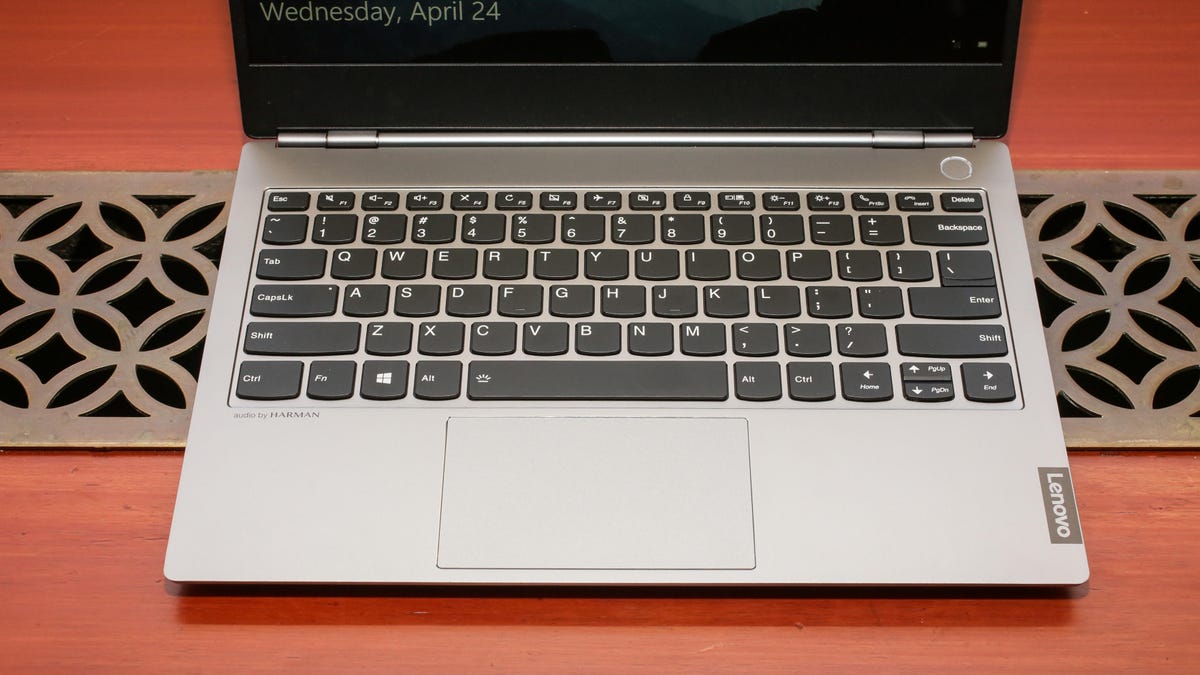
The ThinkBook doesn't have a typical ThinkPad keyboard.
Sarah Tew/CNET
The ThinkPad's carbon black exterior gives way to silvery aluminum for the ThinkBooks. And the ThinkBook breaks with the past in a way the ThinkPad can't without causing a riot: The keyboard has the same sculpted keys, but it puts the ctrl and fn keys in more familiar locations (they're swapped on the ThinkPad keyboard). It also has a mainstream touchpad instead of the TrackPad, and there's no Trackpoint stick.
Why two models in such similar sizes and prices? Variations in regional demands.
Comparative specifications
ThinkBook 13s
ThinkBook 14s
CPU
Up to 8th-gen Core i7
Up to 8th-gen Core i7
Graphics
AMD Radeon 540X or Intel UHD 620 integrated
AMD Radeon 540X
Memory
4, 8 or 16GB DDR4
8, 16GB DDR4
Storage
up to 512GB SSD
up to 512GB SSD
Battery
Up to 11 hours
Up to 10 hours
Display
13.3-inch 1,920 x 1,080 300 nits 72% NTSC gamut
14-inch 1,920 x 1,080 250 nits
Size
12.1x8.5x0.6 in. (308x216x16mm)
12.7x8.8x0.7 in. (323x223x17mm)
Weight
3.1 lbs. (1.4kg)
3.3 lbs. (1.5kg)
Connections
1 x USB-C 3.1 Gen 2, 2 x USB-A 3.1 Gen 1, 1 x HDMI 1.4b, 1 x combo audio
1 x USB-C 3.1 Gen 2, 2 x USB-A 3.1 Gen 1, 1 x HDMI 1.4b, 1 x combo audio
Starting price
$729
$749
They're the same except in a few key ways: The 14s' base configuration has more memory and comes with the AMD discrete graphics. But it also has a lesser screen -- it's bigger but dimmer and with a smaller color gamut -- and the battery life is slightly lower, likely because of the discrete graphics.
On the other end of the spectrum, Lenovo also refreshed its ThinkPad X1 Extreme, its business laptop for people who need a little more power under the hood. The X1 Extreme Gen 2 will be getting an option for a 4K OLED touch display and processor choices up to a ninth-gen Core i9 (8 cores).
Lenovo's also upgrading the discrete graphics from the current Nvidia GeForce GTX 1050 Ti to the newer GTX 1650 Max-Q, which should offer a small bump in performance, though it still feels underpowered for a system that starts at $1,500 (directly converted, £1,150 and AU$2,150). And it will seem especially low-rent if you configure the system with the pricier i9 and OLED panel. But Lenovo's 'real' prices tend to be 10% lower than its nominal prices, so do the math.
The updated model is slated to ship in July, though the OLED option won't appear until closer to the end of August.