Beyond axie infinity web3 games hope to convert crypto currency beyond axie infinity web3 games hope to convert crypto to cash beyond axie infinity web3 games hope to convert crypto kucoin beyond axie infinity web3 games hope to convert crypto binance beyond axie infinity web3 games hope town beyond axie infinity web3 games hope to see you soon beyond axie infinity web3 stocks beyond axie infinity web3 is going beyond axie infinity marketplace beyond anxiety and depression
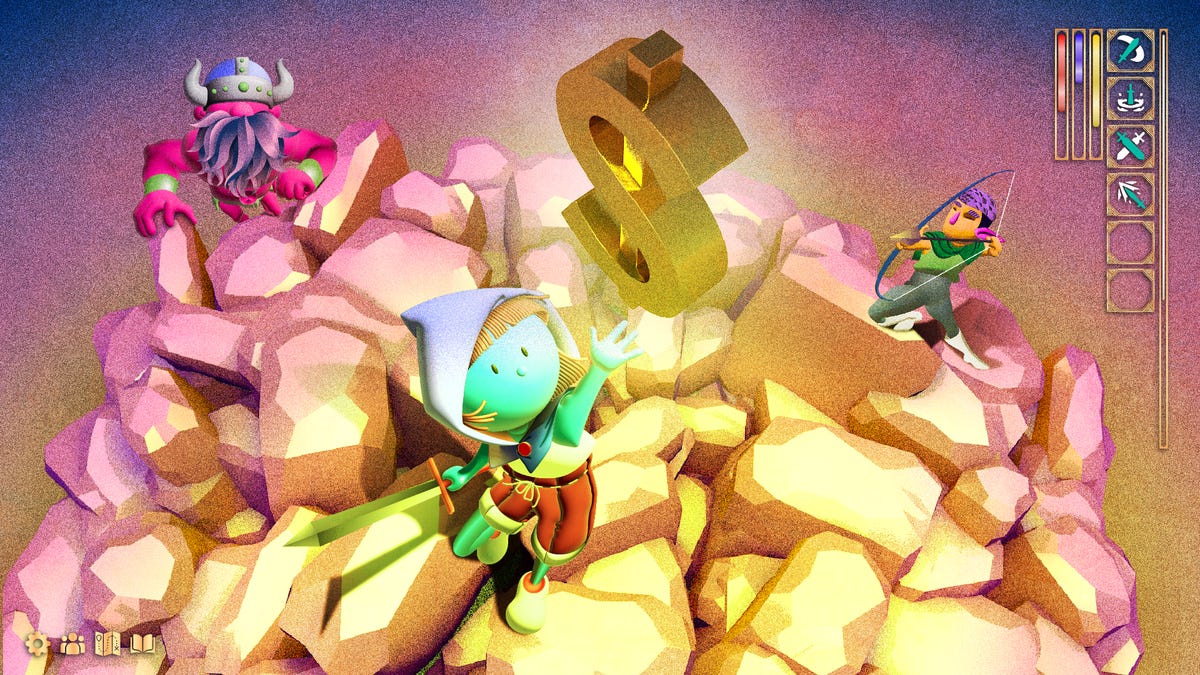
Beyond Axie Infinity: 'Web3 Games' Hope to Convert Crypto Skeptics
The moment Chris saw Axie Infinity, he was hooked. He was once an avid gamer, playing hours of League of Legends every day, but stopped after deciding he was sinking too much time into an unproductive hobby. Axie Infinity promised something different. Inspired by Pokemon, it's a video game about training and battling monsters. That sounds like hundreds of other games, but one element distinguishes Axie Infinity. It's built on the blockchain.
Axies are the Pokemon of Axie Infinity, but they're owned as nonfungible tokens, or NFTs. A cryptocurrency called Smooth Love Potion is earned by battling these Axies. Players can also breed Axies, then either sell or battle with them. Chris, who declined to give his real name and goes only by the pseudonym Cryptobarbarian, felt he could justify playing video games again -- as long as it paid.
"It was fun for the first few weeks, but it gets boring really fast," the 28-year-old said. From there, he said, Axie Infinity became purely about making money.
Axie Infinity is a browser game. Accessing it is free, but you need to buy a team of three Axies to play. At its peak of popularity, bottom-tier Axies cost around $350 each, meaning playing the game once required a four-figure investment. The game allows Axie owners to lease out their monsters to other players, however. A longtime crypto investor, Cryptobarbarian told me he bought $30,000 worth of Axies and loaned them out in return for 40% to 70% of the profits. (CNET wasn't able to verify his purchases.)
The strategy paid off at first. Axie Infinity was a hot ticket in CryptoTown, generating over $15 million a day last August. But thanks to a combination of poor in-game economics, inflation threatening the real world's economy and a $600 million hack reportedly caused by a fake job posting, the price of Axies and the game's Smooth Love Potion cryptocurrency collapsed. The same monsters that cost hundreds of dollars last year now fetch under $10.
"I got around 100 players playing for me with high-end Axies," Cryptobarbarian said to me over Twitter, "which overall cost around $100,000 at the height and are now worth nothing."
To gamers, stories like this provide ample reason to reject "Web3 gaming," a term referring to the integration of NFTs and cryptocurrency into games. The significant carbon footprint of ethereum and bitcoin adds to the resentment. Be it Ubisoft bringing NFTs into Ghost Recon or Square Enix launching Final Fantasy 7 NFTs, gamers have fiercely resisted the blockchain coming anywhere near their industry.
Three Axies in Axie Infinity.
The fear is that crypto and NFTs will deform gaming into a side hustle, transforming its purpose from entertainment to moneymaking. Play-to-earn titles such as Axie Infinity prove the point; they're not games as much as they are financial speculation with the veneer of a game.
"I've never met anyone that played it just for fun," Cryptobarbarian said of Axie Infinity, "only to make money."
But Axie Infinity doesn't represent the future that many Web3 developers envision for gaming. Video game firms, both small and large, are developing titles they hope will clean the slate of Web3 gaming. All are on carbon-neutral blockchains such as polygon or solana, which are far more efficient than ethereum. (Whether they're as secure is an open question.) The goal isn't to make titles that entertain crypto speculators, but rather to make games fun enough that people can justify playing them regardless of whether they earn crypto.
"I've long been a believer that gaming is one of the consumer internet categories that is most likely to bring on mainstream adoption of crypto," said Amy Wu, head of gaming at FTX Ventures, the investment arm of the FTX crypto exchange. "But I also believe when you have a hit game with Web3 elements, it's very likely that the majority of players will never actually trade those tokens. They're just playing the game."
Free to play, play to own
The upcoming wave of Web3 games will range from free-to-play mobile titles to big-budget AAA games for PC and console. On the simpler end of the scale is Shatterpoint. With an art style inspired by Legend of Zelda: Breath of the Wild, it's an action RPG for Android and iOS that, on paper, looks like many top App Store games. There's a single-player campaign plus a PvP multiplayer mode. You earn new weapons and gear as you progress and, much like Fortnite and Call of Duty, the multiplayer is broken up into different "seasons."
But these seasons, segmented by "the shattering" in the game, is where the blockchain comes in. Players will be given a certain list of goals each season. If they complete one -- say, being one of the first 100 players to reach level 50, or staying atop of the PvP leaderboard for a certain amount of time -- their character will be converted into an NFT. Only a limited amount of NFTs will be minted per season.
There are two reasons why players might want to bother scoring an NFT. The shattering acts as an in-game reset, so any gear you've collected will vanish. NFT characters, of which there will be a limited amount each season, are permanent. However your character looks when it's minted into an NFT, with whatever combination of gear equipped, that's how it'll look in perpetuity. The second benefit is that these NFTs can be sold on a marketplace -- if there's a market for them.
A screenshot from Shatterpoint.
There are three crucial elements that make this model sustainable, says Shatterpoint developer Benas Baltramiejunas. First, the game is free to play -- unlike P2E games like Axie Infinity, which requires the upfront cost of three Axie NFTs. Second, none of the items retained as an NFT can resemble "pay to win" mechanics. There can only be cosmetic benefits to owning it, not a competitive edge. Last, and most important, the game is designed with the assumption that most people playing won't be interested in minting their character as an NFT. It has to be fun for them too.
"We're using the NFT approach to create a bit of competitiveness, to incentivize players to play," he said. Shatterpoint is monetized by traditional microtransactions and from taking a small cut of NFT sales -- 2.5% is the traditional cut creators take. Baltramiejunas hopes that focusing on NFTs will result in both better game design and fairer prices. If developers can create a compelling game, revenue can theoretically be sorted out organically through whatever the player base sets as the value of the NFTs.
"In free-to-play games you have whales which account for 10% of the player base but 90% of the revenue," Baltramiejunas said. "If you only have those microtransactions for monetization, you are only focusing on those whales during the content creation, and you're leaving everybody behind. However, with NFT integration, you don't need to monetize that aggressively. The market decides."
NFT brands expand into gaming
While Shatterpoint is a mobile game that produces NFTs, the coming years will see many examples of the reverse: NFT collections turning into games. NFT drops, such as the famed Bored Ape Yacht Club, are doubling as crowdfunding platforms that produce games. Creators earn millions in royalties from sales, and use that money to expand the brand, theoretically boosting NFT prices in the process. Some brands are expanding into TV and film. Many are dabbling in gaming.
One such example is My Pet Hooligan. It's a product of AMGI Studios, an animation studio where former Pixar animator Colin Brady serves as chief creative and technology officer. The studio sees Unreal Engine 5 and blockchain technology as the next technologies that will drive entertainment, Brady told me at the recent NFT.NYC conference.
AMGI Studios' goal of 2021 was to use Unreal Engine 5 to create an animated film for Netflix at half of the traditional cost. While the film was being greenlit, Brady explained, AMGI technical lead Kevin Mack approached him about starting an NFT collection.
The result was My Pet Hooligan, a set of 8,888 3D rabbits. "We sold out in less than a minute, and all of a sudden people started saying, 'hey, when movie? When TV show? When video game?'" Brady said. The studio, filled with Unreal Engine programmers, already had a game in the works.
The result is Rabbit Hole, a sandbox game that looks like a mix of Grand Theft Auto and Ratchet and Clank. Rabbit Hole is currently in closed alpha, available only for My Pet Hooligan NFT holders with only one map functional. The build of the game I saw at NFT.NYC was intriguing. It was certainly incomplete, with noticeable frame-rate issues, but had the clear foundation of a fun sandbox game.
My Pet Hooligan NFTs on the OpenSea marketplace.
Rabbit Hole will eventually be available for PC and console. Brady says the goal is to reach 1 million players by the end of the year. To encourage the type of in-game socialization seen among players of Fortnite and Roblox, the studio developed a companion facial-recognition app for phones. If you perch your phone where a webcam typically is on a computer, it'll track your face and replicate all facial movements on your on-screen Hooligan.
Unlike Shatterpoint, which will integrate just NFTs, Rabbit Hole will use both NFTs and crypto. It will have a play-to-earn mechanic -- or play and earn, as technical lead Kevin Mack prefers to say -- in the form of in-game currency Karrots. These will be used to buy clothing, dances and more for the Hooligan avatars, but it doubles as a cryptocurrency that can be exchanged for ether or bitcoin. You can earn money playing Rabbit Hole, but Brady said it's not going to be life-changing cash.
Then there's the NFT element. This is primed towards holders of the 8,888 My Pet Hooligan NFTs. While players who download the game will start with a generic Hooligan, My Pet Hooligan owners will be able to use their NFT as an avatar in the game.
If the game gets popular enough, Mack said, there will be a certain prestige to owning one of these avatars. But he recognizes that to make that happen, the team has to make a game that people actually want to play.
"Superman No. 1 is valuable because Superman was a great comic," he said. "I think the NFT space for a while started to get that a little backward, where they thought the things were valuable just because they were collectable."
To infinity...
Of all the NFT brands expanding into games, Bored Ape Yacht Club is the biggest. BAYC creators Yuga Labs are developing Otherside, a "metaverse" MMORPG. The term "metaverse" is nebulous, but in this case it refers to an open world where items are owned as NFTs and in-game currency is crypto that can be exchanged for dollars. Details on Otherside are scant, but Yuga has a huge warchest for it. The game's map will be made up of 200,000 plots of land, which players can buy and own. Over $350 million was raised from selling land back in May.
Otherside may be the Web3 game with the highest budget, but perhaps the most ambitious is Star Atlas.
In development since 2020, the Eve Online-inspired Star Atlas is crafted like a traditional AAA game. Michael Wagner, CEO of Star Atlas development studio ATMTA, told me there are around 200 developers working on the game. It's scheduled for release in 2026.
Like Eve Online, Star Atlas is half game, half space simulator. Players ride spacecraft through the galaxy, socializing and battling with each other, exploring exoplanets, mining lands and meteors for resources and so on.
Games like Eve Online are giant, big enough for players to lose themselves in for years. Star Atlas hopes to mimic that feat. On the way to doing so, it uses almost every new tool Web3 offers.
It starts with funding. Wagner said $185 million in revenue was raised in 2021, through the sale of an Atlas token and NFT ships, with a "substantial margin" of that funding development. In the game, ships, items and land will be owned as NFTs. There will be a comprehensive crypto economy built atop the game, which Wagner says will allow for not just a market, but a labor economy too. The economy isn't just in the game; part of Star Atlas will be built on the blockchain, meaning elements will be open source. People will be able to develop apps on top of this data, for things like spacecraft maintenance or resource management.
Part of Star Atlas' economy will involve taxation. Just like in real life, a certain percentage of all sales will go to a treasury. There will be a DAO, or decentralized autonomous organization, in which token holders can vote on how these funds are used, be it to fund a new marketing campaign or a user engagement campaign. Then there will be another DAO specifically for the game itself, where token holders can vote on changes to the game, like additional features or ways to balance combat.
"We've structured the economics of the DAO such that we don't lose control in the near term," Wagner said. "But in the future, it would even be possible for them to vote us out as the principal developer of the game and bring in somebody new if they think they could deliver the product in a superior fashion to us."
Risks and rewards
The potential of Web3 gaming is tremendous, but its challenges are enormous. An examination of Star Atlas alone highlights many issues Web3 developers are likely to face.
First and foremost, making video games is hard. Making high-quality AAA games is harder still, even for veteran game studios, and the Star Atlas game alone is audacious in its ambition. The Web3 components offer additional opportunity for failure: An imbalanced economy, for instance, has the potential to completely break the game. Then there's security and regulation. Crypto has been a digital Wild West for years, with scams endemic. Regulators are slowly changing that. It's an open question whether Web3 gaming can survive in a regulated environment.
"In many countries, consumer protection is the No. 1 driver of regulations. Given gaming is so mainstream, it will be a topic," said FTX Ventures' Wu. "100%, these assets are going to be regulated."
The final issue is the very commodity that fuels crypto tokens and NFT projects: hype. Games are often promised on NFT project road maps before a single second of development has been undertaken. As Brady noted, it took less than a day for My Pet Hooligan holders to demand the announcement of a game, movie or TV show to sustain hype and lift the NFT value. Vaporware is sure to be common.
Games will need to be developed in a way that insulates players from the crypto-rich speculators. Speculators outbidding each other can artificially raise the value of in-game items, which blocks players who actually want to play the game from accessing them. Recall the speculative bubble that caused the cost of entry to Axie Infinity to inflate to over $1,000.
"I'm personally not interested in someone who's paying $100,000 for an NFT," said Brady. "That's a certain echelon. That's not normal society. I'm only interested if this helps every person."
Of all the developers I spoke to, a recurring theme was mistrust of any games company that promises a regular income, or dangles the possibility of earning enough money to quit the rat race. "Play-to-earn is not sustainable and is going to die off," said Baltramiejunas. Instead, the goal is for Web3 games to be more engaging than the games you play today, with the benefit of some pocket money on the side.
"If the game was good I would be satisfied with a little money as long as it's not totally a time waste," said Cryptobarbarian, reflecting on how much money he'd need to earn to justify playing games again.
"If I could earn some lunch money with it, that would be nice. But I think that will take at least a few more years before it happens."
Source